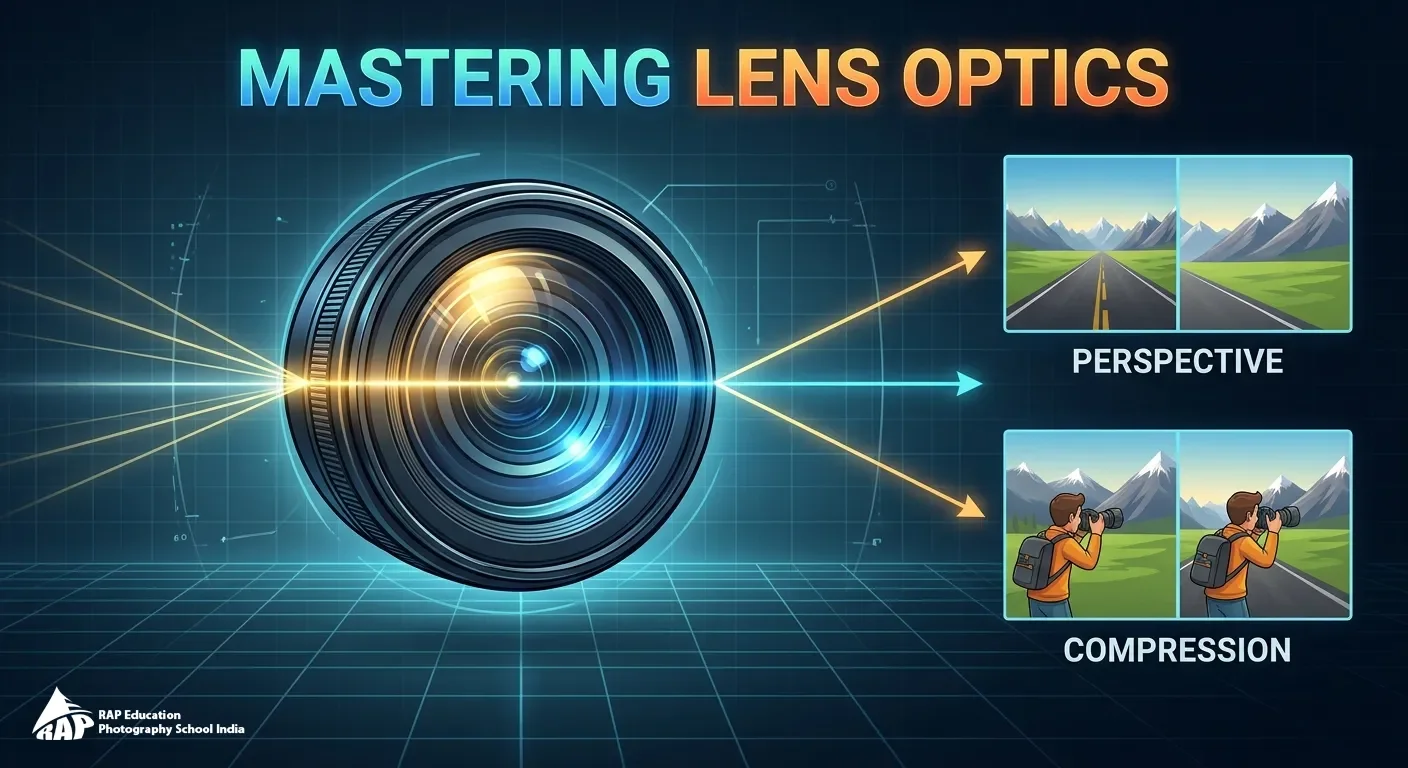
The internet is flooded with a query: which one is most important? The camera or the lens. In this article, we are going to explore the exact question with a rational mind and a little bit of understanding of the camera and lens technology.
If we consider the camera and lens as the human head. The camera lens works like the eye of the camera. Without an eye, the brain won't have any visual data to process as a visual memory in the brain for obvious reasons. The lens is the opening through which light enters a camera and transforms reality into an image. The lens affects the image’s clarity, depth, and feel in the same way that different eyes see differently; some are sharper, while others are blurred. A telephoto lens focuses like an adult focusing on a specific detail, whereas a wide-angle lens may resemble a child’s curiosity by capturing everything at once. To put it briefly, lenses are more than simply glass; they are extensions of the camera’s personality.
Similarly, the camera won't have any data to process if there isn't a lens attached to it. So fundamentally, the lens comes the first place in photography. Without a camera body, a single lens can help you see objects. For this reason, a lot of photographers test lenses by just gazing through them at objects, including the body. This unprocessed “glass view” demonstrates how colors change, distortion bends, and edges become sharper or softer. Before the sensor, shutter, and software adjustments, it i the most basic method of determining how lenses will see the outside world. A photographer’s relationship with a lens frequently starts with that initial impression.
However, it is also true that without the camera body, a lens won't capture the visual in the form of physical or digital data. So the importance of the camera body comes when it's a subject of capturing the visual, not seeing. Consider the camera body that converts the image into memory, the nervous system. What the eye perceives is captured, stored, and sent by it. Vision without it is ephemeral, like viewing a dream you can not remember when you awake up. That brief instant is stabilized by the body and becomes something we can review, discuss, and evaluate. It serves a a mediator between memory and reality.
A camera body, especially its sensor and processing the foremost important part of it. No matter how good the camera is. How great the features and functionalities it offers. If the processor and sensor are not stable, the camera won't perform up to the mark for sure. Similar to a brain with limited memory, a weak sensor loses emotions in translation, colours are erroneous, and details fade. Conversely, processors are comparable to the speed of thought. A slow one will completely miss the moment, while a rapid one can freeze a bird in mid-flight. Sensor and processor work together to determine not only quality but also the photographer’s confidence that what they see will be accurately captured on camera.
Still, a good camera -that has stable processing and a good sensor- is useless if it does not have a good lens attached. As we already mentioned, a lens works as an eye for the camera body. So we require a good camera lens to take the best advantage of a stable camera body. Ironically, a lot of novice photographers spend their money on high-end gear yet choose subpar lenses instead. History has repeatedly shown that remarkable glass combined with small bodies frequently produces famous images. No number of megapixels can make up for optical deficiency because a lens is an image’s soul.
Because even if you have cutting-edge camera performance (processing) in your camera bag, you will get crap images. If you use it with flawed lenses. Inadequate optics cause chromatic aberrations, distortion, and a flatness that cannot be corrected by post-processing. The significance is lost because of the awkward delivery, even though the words are there. It is like trying to write a great novel with a broken pen. For this reason, experts are more fixated on lenses than on bodies. A good lens elevates even mediocre cameras; a bad lens detracts from even the best equipment.
But how would you determine whether a camera has good processing or a sensor in it? Or do you know how to determine the camera lens quality like industry experts? In photography, understanding the camera and lens understanding is the first and foremost important job. Examining the lens is more than just looking at specs. It entails evaluating them in actual circumstances, such as how well they depict highlights at dawn, and if bokeh is distracting or dreamy. In a similar vein, knowing sensors is more about how they respond to stress, low light, strong contrast, and quick action than about how many megapixels they have. The real test of POF technology, according to experts, is not in a controlled laboratory but rather in unpredictably changing situations where life and light collide.
Even if you master the camera and lens operation, without understanding the inside of the camera and lens architecture, you will never be able to utilize the fullest them.
In RAP Education, we have started a program called Fast Track Assistance. To provide you with a comprehensive understanding of the camera and lens, so you never get puzzled about any of them ever.
- #understanding photography
- #things to know before starting
- #How to choose a lens