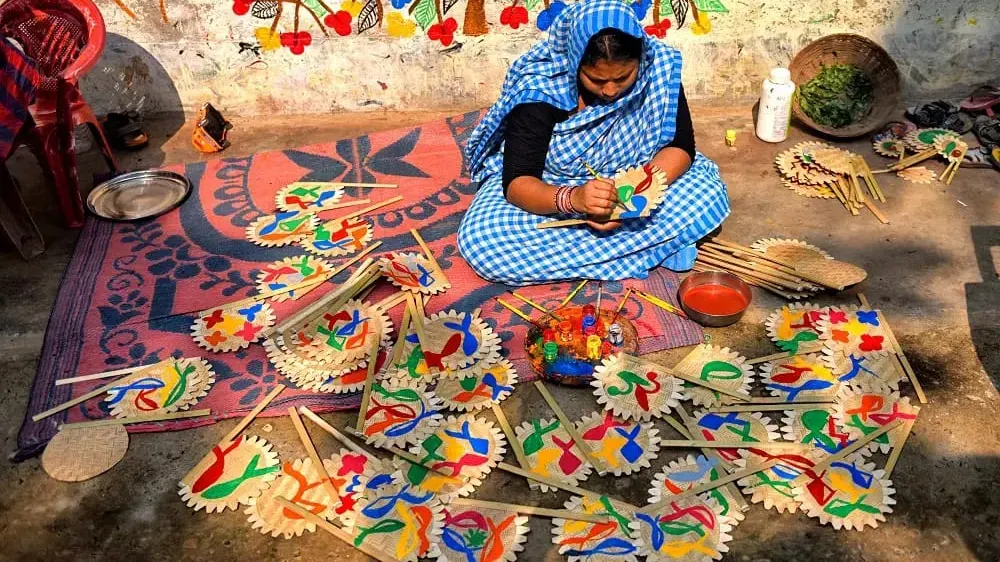
Where the world and cities are running out of time and hurrying in everything, there is a small village where people are tied up with one work for generations. In the busy office work and headaches, we forget to be happy and be ourselves, we fail to appreciate our own culture, our cultural heritage, and the endless enriching art. But I found one place where people didn't forget their culture and heritage. The village's name is Pingla, in India. According to the Census 2011 information, the location code or village code of Pingla village is 342621. This village is in the Pingla subdivision of the Paschim Medinipur district in West Bengal, India. There are approximately 5,253 people, out of which the male population is 2639, while the female population is 2,614.
The village's main attraction is its ancient paintings from scroll painting combined with storytelling through songs, traditionally practiced by the Patua community. The exact year when this art form began in Pingla is not documented, but Patachitra as a tradition dates back centuries, with its origins believed to be linked to the Bengal region’s medieval period. There is no single inventor of Patachitra we know, as it evolved collectively within the community over generations. The artisans (called Patuas) passed their skills down through oral tradition and practical learning, ensuring the preservation of their craft, whereas city people are studying hard to get a job abroad and forgetting their own culture completely.
The village people were very simple, and they all focused on one thing, which was their cultural heritage. The village men and women all worked together, no matter what work was supposed to belong to women and what work should be done by the men. All the villagers were working together, and they were all very far from the typical mentality of a society where women were born to do household work and a man’s responsibility was earning money. Apart from the men and women, they are also not bothered about their religion. In the village, 90% of the artists belong to the “Muslim” religion, but most of the work and storytelling are based on “Hindu” culture. The “Ramayana”, “The Ganga”, “Maa Chandi”, “Maa Sasti”, etc. All these mythical characters belong to the Hindu religion. But the Patuas are doing their job flawlessly, and they have a deeper knowledge of Hindu culture than the people who belong to Hindu culture.
When the two countries were busy fighting about whether their religion was superior to others or not, at the same time, in a small village, a simple artist was busy drawing mythological tales and folklore and singing songs with beautiful, colorful paintings.
From this workshop, I realized that being born in a high-connectivity city, getting an education from a restructured school, and then getting a job and moving abroad can’t give you the peace you will be looking for in your 60s or 70s. But this village taught me that no matter how big or popular you become, peace and happiness are where you start your journey, like every bird has to come to its nest, no matter how far it flies.
- #cultural heritage
- #ancient paintings
- #mythological tales and folklore
- #practical learning