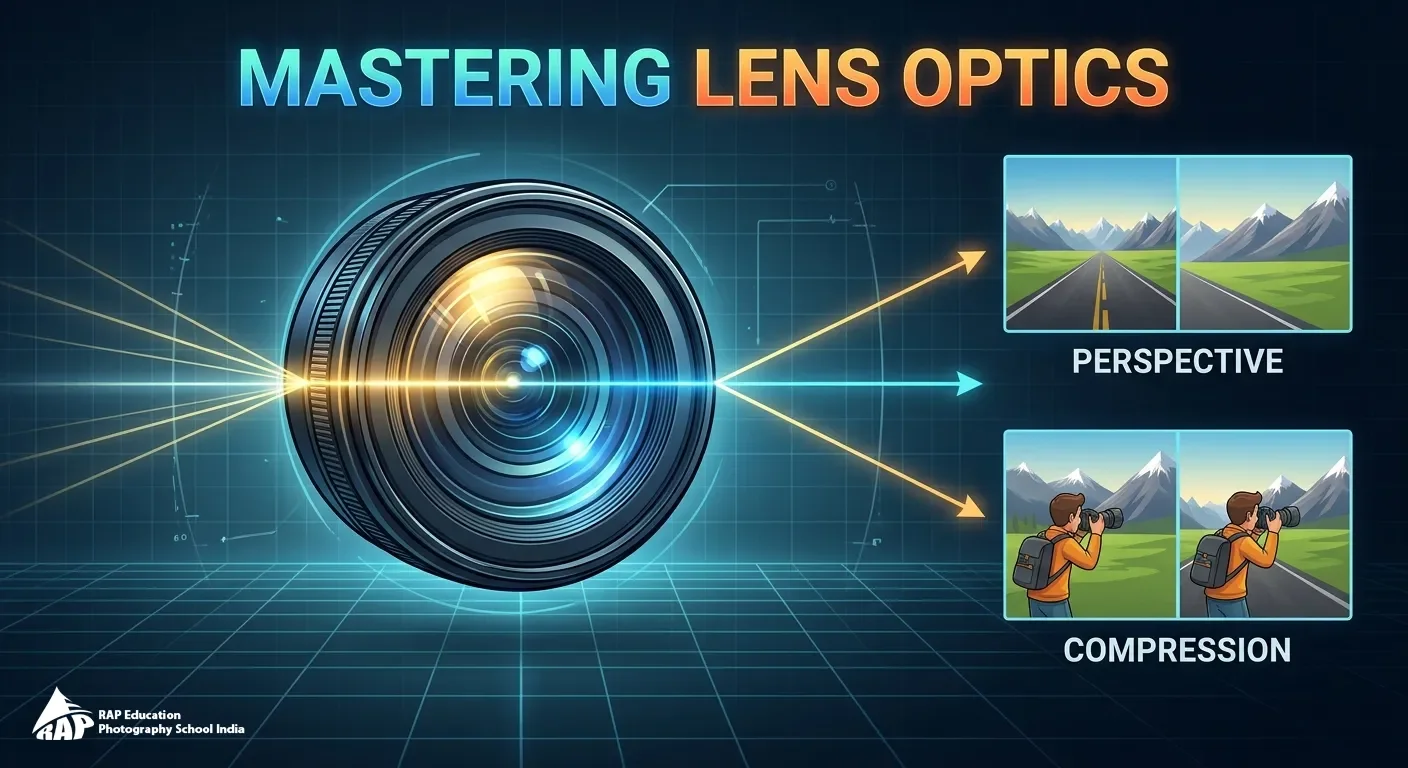

While aperture regulates the volume of light and ISO determines signal amplification, shutter speed introduces the dimension of time to the photographic and cinematic canvas. It is the gatekeeper of temporal motion, deciding whether high-speed physical phenomena are frozen into crystalline fractions of a second or translated into fluid, organic motion blur.
Understanding the physics of exposure duration and shutter mechanics is what separates casual operators from master visual storytellers.
1. The Physics of Shutter Duration: Light Accumulation & Motion
Shutter speed is measured as a fraction of a second (e.g., 1/1000s, 1/250s, 1/50s) or in whole seconds during long exposures.
- The Exposure Relationship: Doubling the exposure time (e.g., from 1/250s to 1/125s) allows twice as many photons to strike the sensor, granting an additional stop (+1 EV) of exposure.
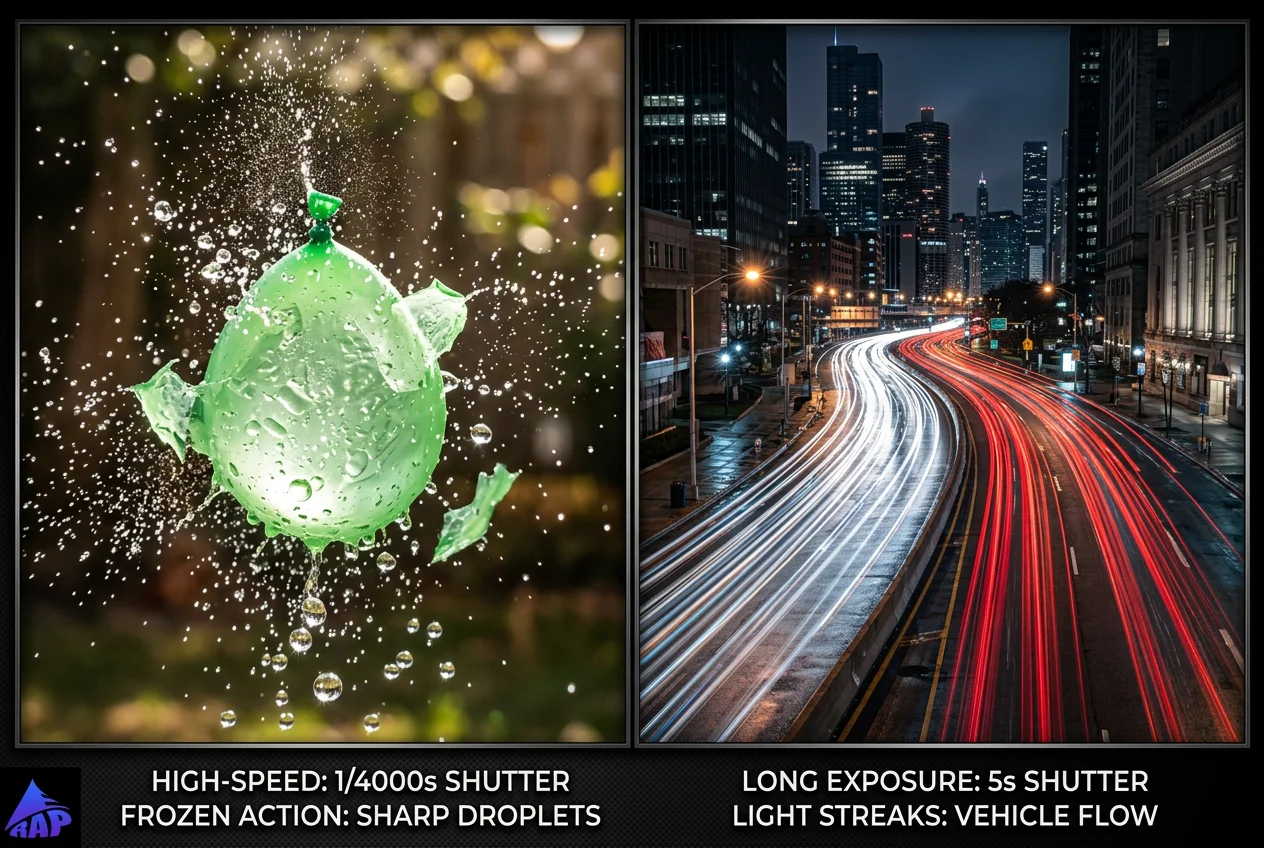
- Temporal Slicing: A short duration (such as 1/4000s) samples an infinitesimal moment of physical movement, freezing droplet splashes, bird wings, or high-speed sports action without perceptible displacement.
- Dynamic Motion Blur: A slower duration (such as 1/4s or several seconds) accumulates continuous movement over time, transforming chaotic ocean waves into ethereal mist and vehicular traffic into radiant light trails.
2. Handheld Sharpness & The Reciprocal Rule
When shooting handheld without a tripod, physiological micro-tremors in human hands introduce camera shake. To guarantee crisp, unblurred frames, photographers adhere to the foundational Reciprocal Rule:
Minimum Handheld Shutter Speed = 1 / (Effective Focal Length in mm)
Crop Factor & Modern Stabilization Considerations:
- Focal Length Multiplication: On a 35mm full-frame sensor with a 200mm telephoto lens, the baseline safe shutter speed is at least 1/200s (or rounded to 1/250s). If using an APS-C crop sensor (1.5x crop factor), the equivalent focal length becomes 300mm, requiring a minimum speed of 1/300s (1/320s or 1/500s recommended).
- In-Body Image Stabilization (IBIS): Modern 5-axis IBIS systems found in professional Sony full-frame bodies provide 4.5 to 8.0 stops of compensation, allowing experienced photographers to shoot handheld at significantly slower speeds while maintaining edge-to-edge sharpness.
3. Shutter Architecture: Mechanical vs. Electronic Focal-Plane Shutters
Digital mirrorless and cinema systems utilize distinct shutter mechanisms, each with distinct optical and temporal characteristics:
A. Mechanical Focal-Plane Shutter
Constructed from ultra-lightweight carbon fibre or metal curtains that travel vertically across the sensor plane.
- Pros: Complete immunity to artificial LED light banding and high-frequency flicker.
- Flash Sync: Governed by the physical travel speed of the curtains (typically 1/200s to 1/250s max sync speed without specialized HSS pulsed strobe output).
B. Electronic Rolling Shutter
The sensor clears its photodiodes and activates readout electronically line-by-line.
- Pros: Completely silent operation, zero mechanical vibration (shutter shock), and ultra-fast burst speeds up to 1/32000s or 1/80000s.
- Cons: High-speed pans or rapid subject movement across the frame can cause rolling shutter skew, as well as vertical banding artefacts under PWM modulated LED stage lights.
4. The 180-Degree Shutter Rule in Cinematography
In motion picture production, frame rate (fps) and shutter duration are locked together to create natural motion blur that matches human vision. This principle originates from mechanical rotary disc shutters in legacy celluloid film cameras.
The Rotary Disc Mechanism
In traditional motion picture cameras, a semicircular disc (half-circle of 180°) spins continuously in front of the film gate at the same speed as the film transport mechanism. For half of each rotation cycle, light exposes the frame; for the other half, the disc blocks light while the next frame is pulled down into the gate.
The Standard Cinematic Formula
To calculate the standard 180-degree shutter speed in digital cinema:
Shutter Speed = 1 / (Frame Rate × 2)
- Standard Cinema (24 fps): 1 / (24 × 2) = 1/48s (or 1/50s on digital mirrorless bodies).
- Broadcast Standard (25 fps / 50Hz regions): 1 / (25 × 2) = 1/50s.
- Slow Motion (60 fps): 1 / (60 × 2) = 1/120s (or 1/125s).
- High-Speed Cinema (120 fps): 1 / (120 × 2) = 1/240s (or 1/250s).
Creative Deviations from 180 Degrees:
- Narrow Shutter Angle (e.g., 45° or 90° / 1/200s at 24fps): Produces ultra-crisp, staccato, hyper-realistic motion with minimal motion blur, popularized in visceral combat sequences (e.g., Saving Private Ryan).
- Wide Shutter Angle (e.g., 270° or 360° / 1/24s at 24fps): Generates excessive, dreamlike motion smear, ideal for simulating disorientation, low-light nightscapes, or intoxication.
5. Practical Application: Neutral Density (ND) Filters
Because cinematography requires locking your shutter speed to the 180-degree rule (e.g., 1/50s at 24fps), shooting outdoors in bright sunlight with a wide aperture (such as f/1.4 or f/2.0 for shallow depth of field) would lead to massive overexposure.
To maintain both your creative depth of field and correct cinematic motion blur, filmmakers employ Variable Neutral Density (VND) or Circular Polarizing (CPL) Filters as physical sunglasses for the lens, cutting incoming light transmission without altering colour temperature.
6. Master Motion & Cinematic Physics at RAP Education
Mastering the precise balance between shutter dynamics, lens optics, and lighting physics is fundamental to professional filmmaking and high-end commercial photography.
At RAP Education Photography School, our industry-aligned curriculum moves beyond basic camera buttons into deep visual mechanics. Through our 18-Month Understanding Photography & Cinematography Professional Learning Program and comprehensive 15-Month Professional Course, students gain hands-on training with professional Sony mirrorless systems, cine lenses, and complete studio lighting setups.
Visit our state-of-the-art Phoolbagan Campus in Kolkata to learn directly under Riddhi Bhattacharjee and build an industry-ready portfolio backed by 100% placement support.
- #Shutter Speed Guide
- #180 Degree Shutter Rule
- #Cinematography Shutter Angle
- #Reciprocal Rule Photography
- #Freezing Motion
- #Long Exposure Photography
- #Photography Courses in Kolkata
- #Cinematography School Phoolbagan